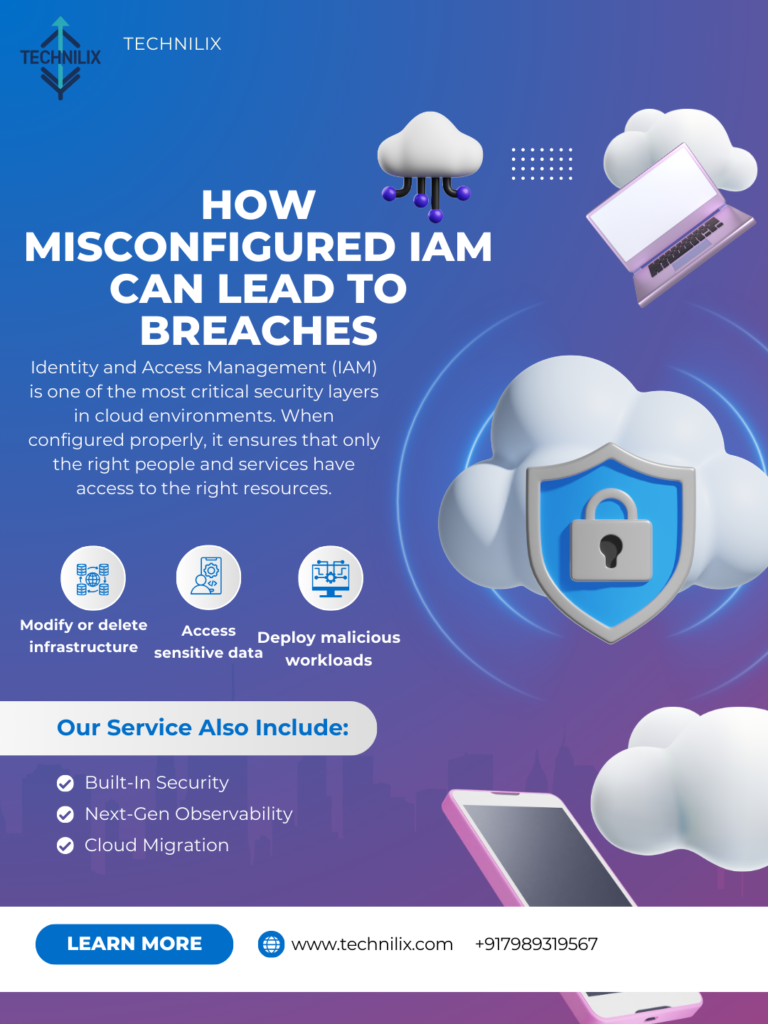
Identity and Access Management (IAM) is one of the most critical security layers in cloud environments. When configured properly, it ensures that only the right people and services have access to the right resources.
But when IAM policies are misconfigured, they can open the door to serious security breaches.
Common IAM Misconfigurations
• Overly permissive access policies (e.g., full admin privileges)
• Shared credentials across teams or services
• Unused or forgotten access keys
• Lack of role-based access control (RBAC)
• No multi-factor authentication for privileged accounts
In cloud platforms like Amazon Web Services, Microsoft Azure, and Google Cloud Platform, IAM misconfigurations are one of the leading causes of data exposure and unauthorized access.
Why This Is Dangerous
A single overly permissive IAM role can allow attackers to:
• Access sensitive data
• Modify or delete infrastructure
• Deploy malicious workloads
• Escalate privileges across the environment
Once attackers gain access, they often move laterally across cloud resources using these permissions.
Best Practices for DevOps Teams
✔ Follow the principle of least privilege
✔ Implement role-based access control (RBAC)
✔ Enable multi-factor authentication (MFA)
✔ Regularly audit IAM policies and access keys
✔ Rotate credentials and remove unused permissions
Strong IAM governance is essential for securing cloud-native environments.
In the cloud, identity is the new security perimeter.
Join Realtime Program with handson to Business client projects. hashtag#Call on +917989319567 / whatsapp on https://wa.link/ntfq3m
—————————–
Regards,
Technilix.com
Division of MFH IT Solutions (GST ID: 37ABWFM7509H1ZL)
☎️ Contact Us https://lnkd.in/gEfhFidB
LinkedIn https://lnkd.in/ei75Ht8e
#MFH #DevOps #CloudSecurity #IAM #CyberSecurity #DevSecOps #AWS #Azure #GoogleCloud #CloudComputing #SecureDevOps #CI_CD #InfrastructureAsCode #CloudNative #PlatformEngineering