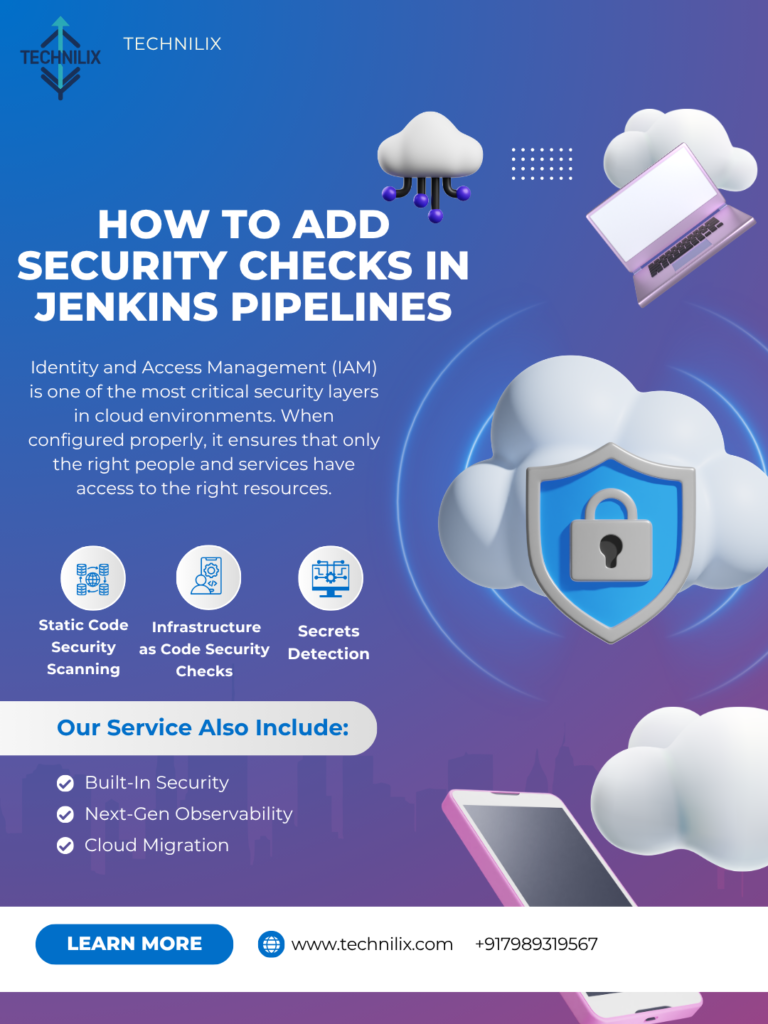
CI/CD pipelines move code to production faster than ever. But if security checks are missing, vulnerabilities can move just as quickly into live environments. Integrating automated security scans directly into pipelines helps detect risks early and prevents insecure builds from being deployed.
Using platforms like Jenkins, DevOps teams can embed multiple security validation steps into the pipeline to ensure every build is tested, scanned, and verified before release.
Key Security Checks to Add in Pipelines
1. Static Code Security Scanning
Use SAST tools to analyze source code and detect vulnerabilities such as injection flaws, insecure dependencies, or weak cryptography.
2. Dependency Vulnerability Scanning
Open-source libraries can contain known vulnerabilities. Automated scanners check dependency versions against security databases.
3. Container Image Security Scans
If your pipeline builds containers with Docker, tools like Trivy can scan images for vulnerabilities before pushing them to registries.
4. Infrastructure as Code Security Checks
Infrastructure templates used with tools like Terraform should be scanned to detect insecure cloud configurations.
5. Secrets Detection
Pipelines should scan repositories to detect accidentally committed secrets such as API keys or tokens.
Secure pipelines lead to secure production environments.
Join Realtime Program with handson to Business client projects. hashtag#Call on +917989319567 / whatsapp on https://wa.link/ntfq3m
—————————–
Regards,
Technilix.com
Division of MFH IT Solutions (GST ID: 37ABWFM7509H1ZL)
☎️ Contact Us https://lnkd.in/gEfhFidB
LinkedIn https://lnkd.in/ei75Ht8e
#MFH #DevOps #DevSecOps #Jenkins #CI_CD #CyberSecurity #CloudSecurity #SecureDevOps #Docker #Terraform #Automation #CloudNative #PlatformEngineering #InfrastructureAsCode